Solvers at the Edge: Embedded Optimization for Safe and Intelligent Robotics
Abstract
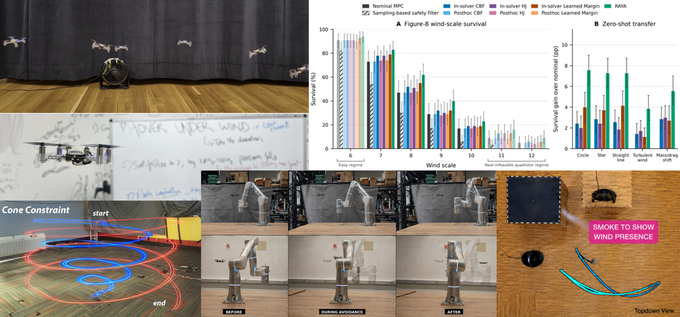
Model predictive control (MPC) provides a principled framework for real-time decision making under dynamics and constraints, and has become a central tool in robotics for agile trajectory tracking, disturbance rejection, and safety-critical control. However, many robotic platforms of practical interest, including nano-aerial vehicles and other edge robotic systems, operate under severe limits on memory, compute, and power. These constraints make expressive optimization-based controllers difficult to deploy when real-time performance, robustness, and safety guarantees are required simultaneously. This thesis studies structure-exploiting embedded optimization methods that extend cached Riccati-based MPC solvers for resource-constrained robotic systems. Building on first-order alternating direction method of multipliers (ADMM) solvers and offline caching, this thesis develops three complementary contributions. First, we develop conic extensions of embedded MPC solvers that support second-order cone constraints, allowing richer modeling of thrust, friction, and glideslope constraints while retaining real-time deployability on microcontrollers. Second, we present a semidefinite programming framework for embedded MPC that enables certifiable obstacle avoidance through lifted convex relaxations and an a posteriori rank-1 safety certificate. Third, we introduce First-Order Adaptive Caching, a sensitivity-based method for updating cached solver quantities online as the ADMM penalty parameter changes, improving convergence without sacrificing caching benefits. Together, these methods expand cached embedded MPC along three dimensions: expressiveness, safety, and robustness. Across simulation, microcontroller benchmarks, and Crazyflie hardware experiments, the resulting solvers demonstrate improvements in constraint handling, solve time, and safety-critical behavior under aggressive and dynamically changing conditions.