Hardware-Algorithm Co-Design for Real-Time Linear Model Predictive Control: FPGA Implementation and Deployment on a Resource-Constrained Quadrotor
Hardware-Algorithm Co-Design for Real-Time Linear Model Predictive Control: FPGA Implementation and Deployment on a Resource-Constrained Quadrotor
Abstract
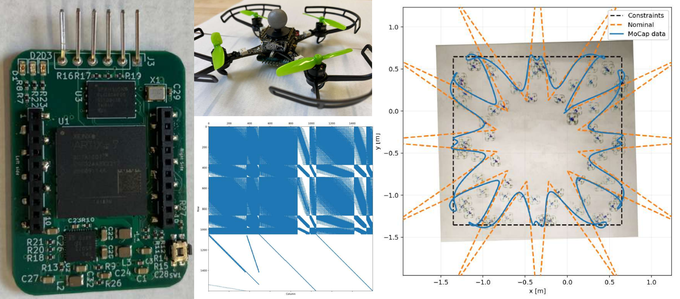
Model Predictive Control (MPC) is a powerful framework for feedback control, enabling controllers that explicitly account for system dynamics and operational constraints. However, the need to repeatedly solve a constrained optimization problem online makes MPC computationally expensive and energy-intensive, posing a fundamental challenge for deployment on resource-constrained robotic platforms. For small embedded robots such as nano-quadrotors, this challenge is acute. Recent work has demonstrated that carefully formulated linear MPC can run onboard microcontrollers, but such platforms face hard limits in computational throughput and energy budget. As problem complexity grows with longer prediction horizons, tighter iteration budgets, or stricter constraints, microcontroller-based implementations become impractical. Custom computing hardware offers a path forward. By tailoring computation to the structure of a specific algorithm, domain-specific hardware can achieve substantial improvements in both throughput and energy efficiency compared to general-purpose processors. Field-Programmable Gate Arrays (FPGAs) provide a flexible platform for prototyping such custom architectures, while Application-Specific Integrated Circuits (ASICs) can deliver even greater efficiency in production systems. Emerging neuromorphic architectures offer a complementary direction, with the potential for ultra-low-power operation through fundamentally different computational principles. This thesis investigates how such alternative architectures can extend the capability of optimizationbased control on constrained robots, with demonstrations on a nano-quadrotor running linear MPC. The primary contribution is a hardware-accelerated linear MPC solver based on a custom FPGA datapath implementation of the Alternating Direction Method of Multipliers (ADMM) algorithm, co-designed for reduced-precision arithmetic. We also develop a custom FPGA expansion board for the Crazyflie platform. Through these advances, we demonstrate fully onboard constrained MPC at high control frequencies, achieving approximately 15× lower solver latency and 200× improvement in energy–delay product relative to state-of-the-art baselines. This enables longer horizons, more solver iterations per control step, and more reliable constraint handling. In parallel, a preliminary feasibility analysis of mapping iterative optimization algorithms onto Intel’s Loihi 2 neuromorphic processor is explored as a promising direction toward ultra-low-power implementations in future work. Together, these contributions illustrate how algorithm-hardware co-design can significantly extend the practicality of optimization-based control on resource-constrained robotic platforms.
