
Release measurements#
Note
September/October 2026 Updated Results: 300 selected worker processes and 1,800 measurements, all passing the strict numerical checks. The selection includes the Pinocchio 24-worker follow-up, allocate-once wrapper calls, and the updated GRiD Hessian kernels. Capture hashes and per-cell provenance are retained with the tables.
These measurements cover iiwa14 (fixed base, 7 velocities), go2 (floating base, 18 velocities), and G1 (floating base, 35 velocities) on one NVIDIA RTX 5090 GPU and 24-core Intel Core Ultra 9 285K CPU system. Timings and relative speedups vary across platforms. Batch sizes are 16, 32, 64, 128, 256, and 1024. The main figures compare RNEA, its analytical gradient, and its analytical Hessian. The wrapper study covers the same three operations through CUDA C++, the C ABI (RNEA and its gradient), NumPy, JAX, and PyTorch, with each Python surface measured as its default call and with its buffers allocated once and reused.
The main collection used commit e92477857b0ca53fb307a8fa4799a4afd5757177.
It includes the floating-base JAX Hessian packing correction and preserves
fp64 mapped inputs for Pinocchio’s analytical paths. No numerical tolerance
was relaxed. Subsequent figure and documentation edits do not alter timed code.
The wrapper addendum used commits 53119f2d4c0b1297af19b9bd266879828001c566
and ab20188681334da365753b42da5f0021c4c70add (the latter for the JAX
allocate-once cells). Between the two collections the bindings changed in the
ways Figure 4 describes; the generated CUDA did not. A same-day drift check
re-measured GRiD’s native CUDA call on all 18 RNEA-gradient cells: both its
compute-only and its host call landed within 0.6% of the September values.
The Hessian addendum used commit effabf8698fa6af191d5c24867471e971a76880e.
It optimized generated CUDA including idsva_so in both frames,
plus the crba, Coriolis, integrator-gradient and end-effector kernels:
block barriers that ordered nothing were removed and a few small
intermediates are re-formed in registers instead of shared memory, with the
output verified bit-identical to the previous kernels before timing. The iiwa14
launch configuration was re-tuned for the new kernel (its best block size
moved). Every other timed kernel is byte-identical; the drift check above
was repeated on all 36 RNEA cells of the three robots (worst deviation 0.62%).
The baseline-density addendum of 7 October used commit 11c23dab285971879145342aef8cb01281d359c9.
It changed no GRiD code: it added adapters so that more of the baselines’
public operations are matched and timed. Frax’s floating-base model (six
prepended prismatic and Euler joints, nq == nv) is now mapped to the shared
quaternion fixture through the exact velocity map between the two coordinate
systems, so go2 and G1 gain Frax cells for RNEA, gravity, bias, CRBA, M⁻¹,
forward dynamics and the end-effector pose; Frax’s autodiff gradients are
timed on iiwa14. The end-effector pose gradient, d[xyz; rpy]/dv, is now
matched for Pinocchio (both API modes), MuJoCo CPU, MJX, MuJoCo Warp and Frax
through one analytic map from each library’s world-frame Jacobian to RPY
rates (MJX and Frax by autodiff of the pose). cuRobo’s native CUDA RNEA was
also wired on the shared iiwa14 URDF and failed the oracle gate (23%
relative L2 error: its development URDF parser doubles every inertial-origin
offset and discards the parsed inertia tensor), so it has no timing row; the
audit records the attempt. These cells follow each table’s existing protocol
(300 samples for RNEA and its gradient, 30 for the secondary table) and were
collected on an otherwise idle machine.
What the measurements show#
GRiD’s strongest performance is available to solvers and libraries that keep robot data on the GPU. The measurements also show that this advantage can survive transfers and framework dispatch, rather than being limited to the compute-only boundary.
Fast robot-specific CUDA for GPU-resident applications. GRiD’s native compute-only call has a lower median than every evaluated GPU baseline on its matched core RNEA/gradient cells. Against MuJoCo Warp and MJX, the ratios span 4.3–38.6×. These are resident-call comparisons, not isolated kernel comparisons: GRiD includes native launch and synchronization; the competitors also include their framework dispatch.
GRiD’s JAX API is faster than MJX on all 36 matched RNEA/gradient cells. The ratios are 1.8–4.7× for complete host-to-host calls and 2.2–14.7× with inputs and outputs resident on the GPU. Every one of these comparisons remains above 1× across the observed ranges of the three process means. These are measured ranges, not statistical confidence intervals.
Large-batch gradients show substantial compute and host-call gains. At batch 1024, GRiD’s compute-only CUDA calls for RNEA gradients are 2.5× faster on iiwa14 and 3.7× faster on go2 than Pinocchio codegen’s CPU calls. GRiD takes 30.8 µs and 116.6 µs, respectively, versus 78.2 µs and 433.5 µs for Pinocchio codegen. The compute-only comparison excludes GRiD’s transfers but includes native launch and synchronization. Including transfers, GRiD’s C++ host calls take 59.4 µs and 257.3 µs, retaining 1.3× and 1.7× speedups at the matched host-to-host boundary. These host-call wins remain separated across the observed repeat ranges.
Larger batches turn compute gains into host-call wins. Including transfers, GRiD’s CUDA host call has a lower median than the Pinocchio codegen-mode adapter in 10 of 45 core cells at batches 16–256; 8 of those wins remain separated across observed ranges. At batch 1024, it wins 5 of 9 cells across those ranges. Both Pinocchio modes use the same standard analytical fp64 path for Hessians, not a code-generated Hessian. Pinocchio wins many small-batch comparisons, particularly the lighter RNEA workload when GRiD’s transfers are included. The batch-1024 wins include all three robots’ Hessians and the iiwa14 and go2 gradients. Full GRiD JAX calls do not beat the updated Pinocchio codegen-mode adapter in these core cells.
Peak Hessian gains reach 3.3× including I/O and 13× compute-only. The host-call peak is iiwa14 at batch 256: GRiD takes 111.8 µs versus Pinocchio’s 365.6 µs. The compute-only peak is G1 at batch 1024: GRiD takes 4.58 ms versus Pinocchio’s 59.56 ms. Both compare GRiD fp32 with Pinocchio’s standard analytical fp64 Hessian path; neither is a JAX speedup or a same-precision comparison.
Wrapper costs matter. GRiD JAX resident calls beat MuJoCo Warp on all 18 matched RNEA cells across observed ranges, but the host-to-host results are mixed. On iiwa14 RNEA at batch 256, median full calls are 23.3 µs in CUDA, 24.7 µs through the C ABI, 26.8 µs through NumPy, 61.0 µs through PyTorch, and 224.8 µs through JAX. This is one illustrative cell, not a universal wrapper overhead.
Allocating once removes most of the NumPy and PyTorch wrapper cost. A default Python call allocates its output on every call. With the buffers created once and reused, NumPy and PyTorch are faster in all 90 measured cells, and at batch 1024 they land within 10% of the C++ host call on the go2 and G1 gradients and Hessians (from 1% faster to 9% slower). G1’s RNEA gradient at batch 1024 takes 1.13 ms in C++, 1.18 ms through NumPy and 1.14 ms through PyTorch, against 2.79 ms and 3.32 ms for their default calls; its Hessian takes 37.3 ms, 37.5 ms and 38.7 ms against 107.9 ms and 236.4 ms. JAX’s
to_hosthelps on large outputs (40.9 ms against 130.1 ms on that Hessian) and is the default download below 256 KiB.
Figure 1 — Where the time goes#
Keeping data on the GPU makes the most of GRiD’s compute performance. Larger batches can amortize transfers, with host-call wins extending to analytical Hessians on all three robots at batch 1024. Full JAX calls can also win, as the iiwa14 gradient example above illustrates; the crossover depends on the operation, batch size, robot, and baseline. Pinocchio wins many small-batch host-call comparisons, especially for RNEA; GPU execution is not the fastest choice for every workload.
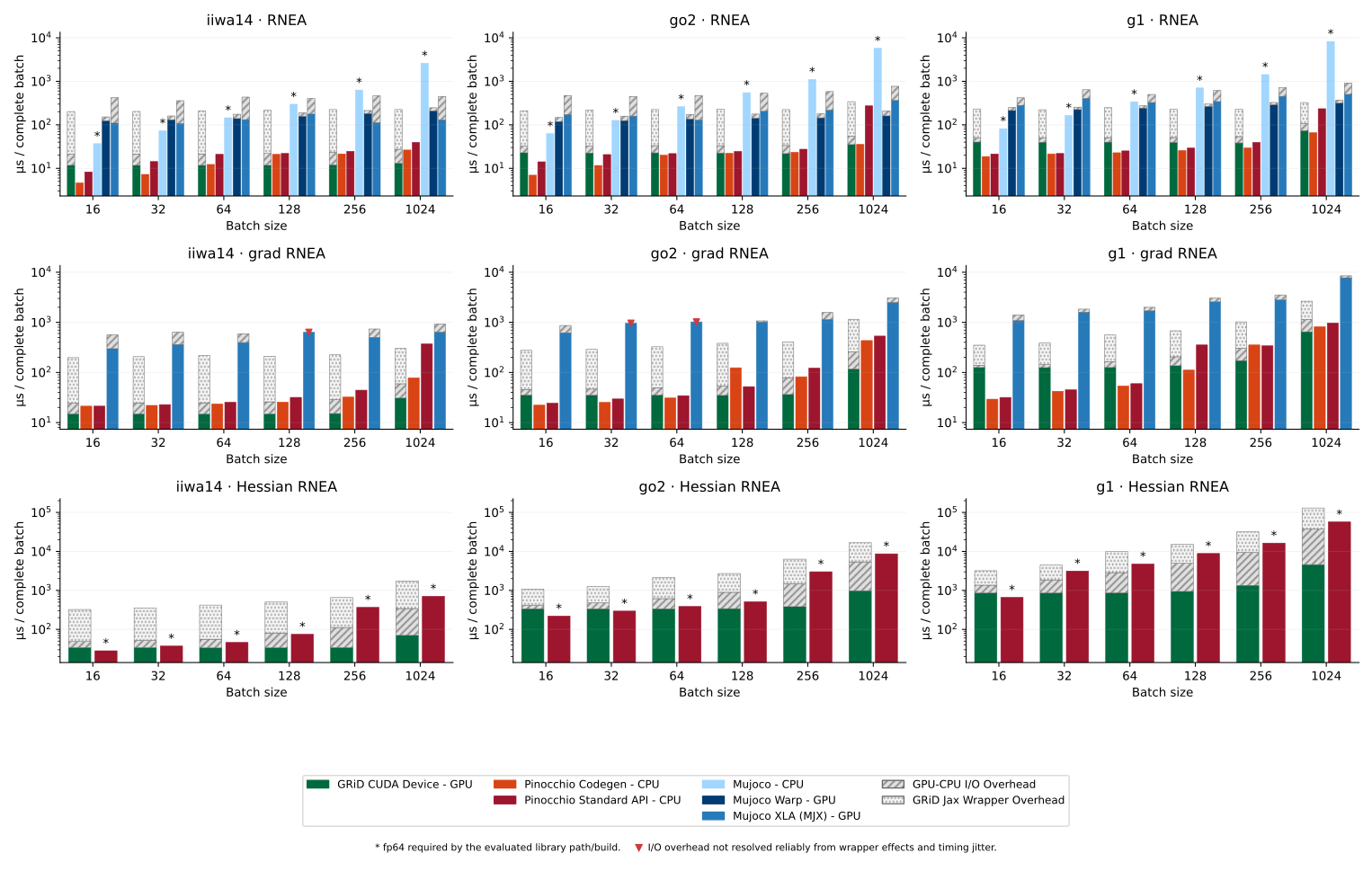
Absolute microseconds per complete batch, on a log axis. GRiD’s JAX full-call bar is decomposed into its native CUDA compute-only call, the CUDA transfer increment, and the additional JAX API increment. Green denotes the CUDA call, gray diagonal hatching the GPU–CPU I/O increment, and gray dots on white the JAX wrapper increment. These are differences of measured call times, not isolated measurements of individual wrapper components. The CUDA compute-only call includes native host launch and synchronization; it is not CUDA-event timing of a bare kernel.
GPU competitors show resident calls plus full-call increments when the decomposition is consistent. Pinocchio’s two API modes are separate bars for RNEA and its gradient. Only its standard analytical fp64 API is shown for the Hessian; there is no codegen Hessian bar. BARD and Frax remain in the tables but are omitted from this figure for clarity. A red triangle means the decomposition is unavailable and the measured full-call total is shown without a stack. Three MJX gradient cells have this flag because at least one repeat’s resident time exceeded its full-call time, even though the median difference is positive. Neither boundary is discarded or clamped.
Figure 2 — Speedup against Pinocchio (CPU)#
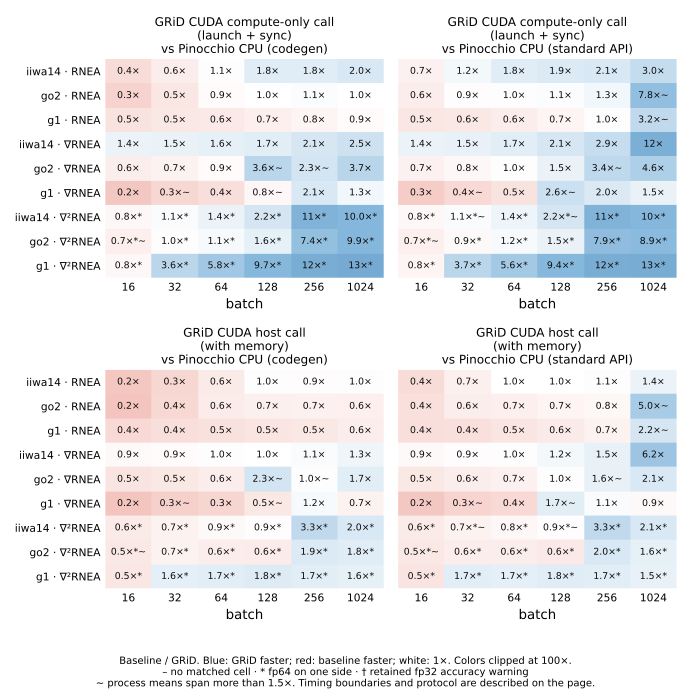
Ratios are baseline time divided by GRiD time. Above 1× favors GRiD; below 1×
favors the baseline. The top row excludes GRiD’s host–device transfers and is
therefore a different workload boundary from Pinocchio’s host-array call.
The bottom row includes GRiD’s transfers and compares host arrays in and out
on both sides. Pinocchio uses a persistent C++ thread pool, choosing the best
recorded candidate from {1, 2, 4, 8, 16, 24}, excluding counts above the
batch size. All 24 logical CPUs were available. The 24-worker ceiling is a
study setting, not a Pinocchio limit. Selected counts and all tested variants
are retained in the raw captures. The secondary-operation table retains its
original eight-worker ceiling and is not part of this follow-up.
Pinocchio’s CPU paths are strong at small batches, particularly for RNEA. Transfers can reverse a compute-only advantage: for iiwa14’s RNEA gradient at batch 32, GRiD’s compute-only call takes 14.8 µs versus 22.0 µs for Pinocchio codegen, but GRiD’s full C++ host call takes 24.6 µs.
Figure 2b — GRiD kernel against the CPU libraries, no I/O#
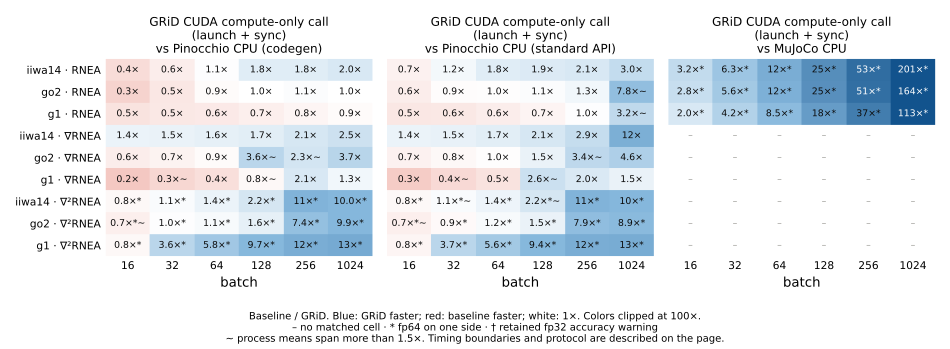
The same ratios at the compute-only boundary for all three CPU baselines:
GRiD’s row excludes its host–device transfers (launch and synchronization
only, data resident on the GPU), while each CPU library is its warmed
host-array call — Pinocchio through its thread pool as above, MuJoCo CPU as a
per-sample mj_inverse loop in fp64. This is the view for a solver that
keeps its state on the device; Figure 2’s bottom row and the homepage figure
are the host-to-host view.
Figure 3 — Speedup against the GPU libraries#
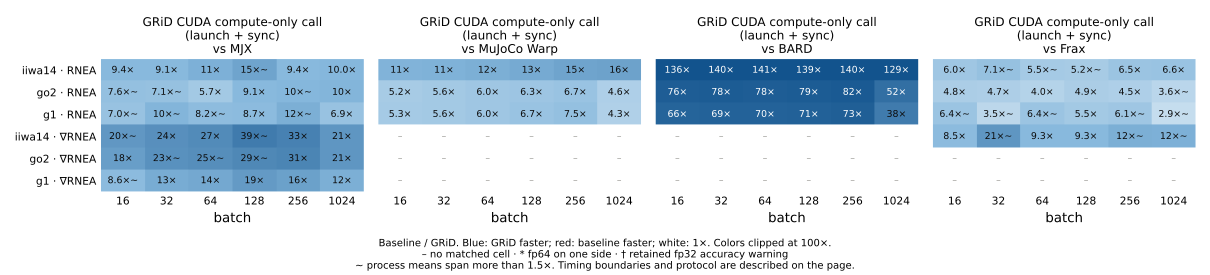
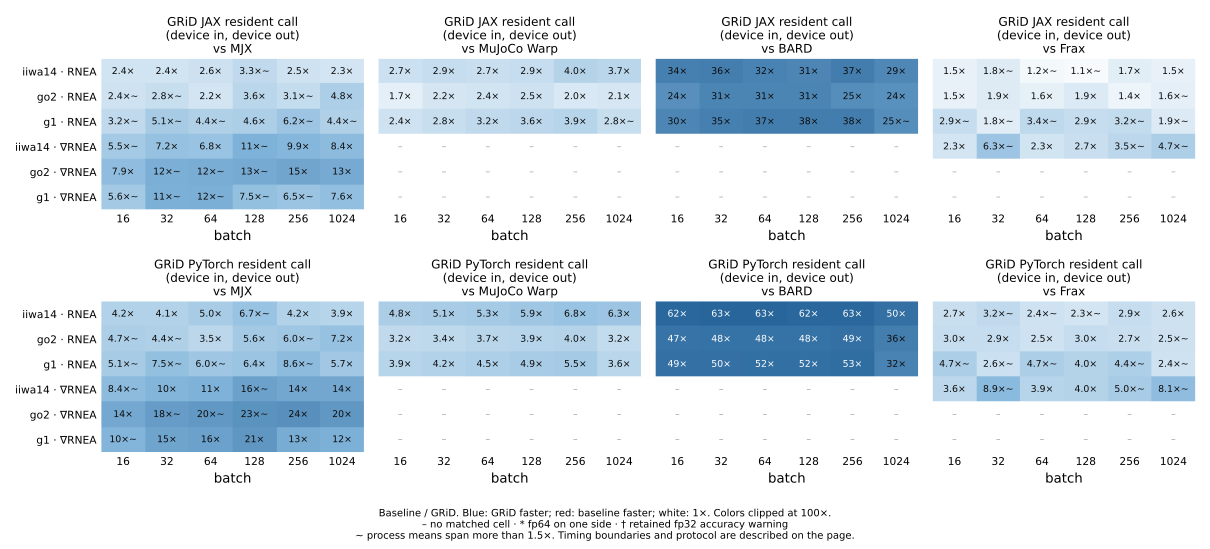
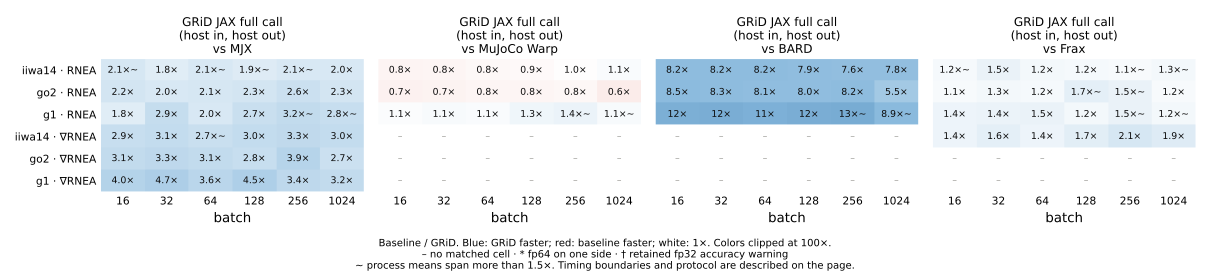
Top: native CUDA compute-only calls against competitors’ resident API calls. Both include launch and synchronization, but only the competitors pay framework dispatch. Middle: resident API calls with framework dispatch on both sides — GRiD through JAX (top row) and through PyTorch (bottom row). Bottom: full host-to-host calls on both sides. These boundaries answer different application questions and must not be combined into one unqualified speedup claim.
Heatmaps show ratios of medians, not guarantees of separation across repeat
ranges. ~ marks a side whose run means span more than 1.5×. Colors are
clipped at 100×; printed cell values retain the measured ratios. Missing cells
reflect adapter coverage, model mismatch, or study scope, not library-wide
incapability. No finite-difference or nested-autodiff Hessian sweep was added
to this analytical-Hessian comparison.
Figure 4 — Wrapper costs#
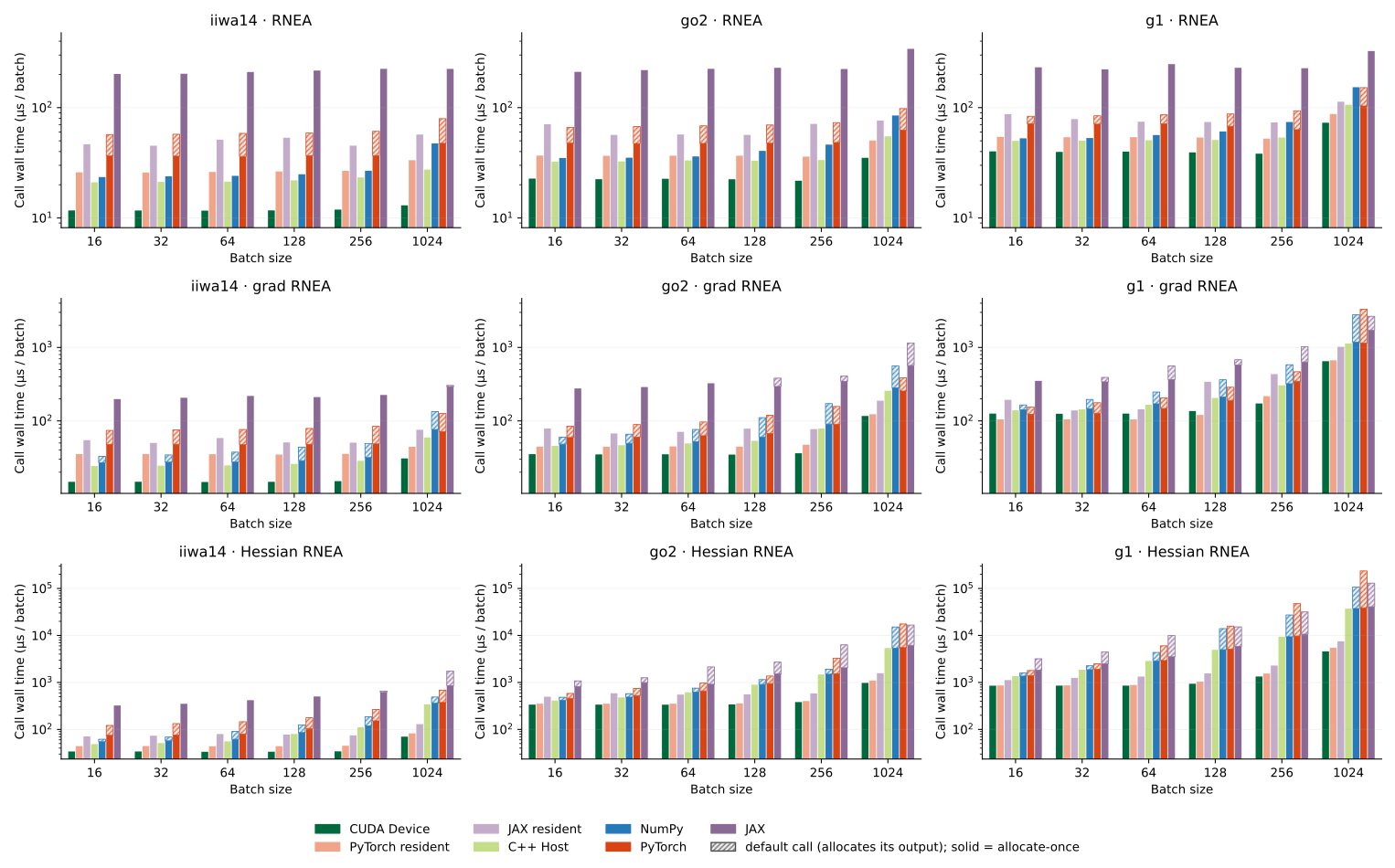
Bars show the measured wall time at each call boundary, ordered CUDA Device, C++ Host, NumPy, PyTorch, JAX. CUDA Device is the native compute-only call with resident data, including launch and synchronization; it is not bare device-event timing. C++ Host includes transfers with prepared host buffers. The Python bars are complete host-to-host API calls, and each shows two measurements in one slot:
the solid bar is the allocate-once call: the I/O buffers are created once, outside the timed window, and every timed call reuses them;
the hatched cap above it reaches the default call, which allocates its output on every call.
The three left-most bars of each slot are the no-I/O boundary: CUDA Device (the native compute-only call, data resident), then the same boundary through PyTorch and JAX (device tensors or arrays in and out, synchronised). The gap between CUDA Device and a resident framework bar is that framework’s dispatch alone; the host-call bars to their right add the I/O mechanism on top, and the hatched caps add the per-call output allocation on top of that. Resident, the wrappers are low-overhead; what they add is I/O and allocation.
The allocate-once calls are, per surface: NumPy — out= with a page-locked
buffer from handle.pinned_empty (the gradient and Hessian; RNEA has no
out=, so its bar is the default call); PyTorch — page-locked host tensors
for inputs and outputs with non-blocking copies
(pinned_host_like / copy_to_host); JAX — grid_rbd.jax.to_host.
to_host uses its page-locked route only for arrays of at least 256 KiB and
is otherwise the default download itself, so a JAX allocate-once bar is drawn
only where that route was taken (23 of 54 cells); for RNEA every JAX slot is one
solid bar because its outputs stay below that floor, where the page-locked route
would be slower than the default download. A short black tick marks the
one cell where the default call was not the slower of the two (JAX, iiwa14
gradient at batch 1024, by 6%).
Default and allocate-once are the same compiled artifact and the same operation; only the buffer handling differs. NumPy and PyTorch are faster with reused buffers in every measured cell: by 1.1–2.9× for NumPy and 1.2–6.0× for PyTorch, growing with output size. Where the JAX page-locked route applies, the median gain is 1.3× on gradients and 2.1× on Hessians, up to 3.4×.
The C ABI remains available in the downloadable data but is omitted from this application-facing figure. Its RNEA-gradient call, and the NumPy call built on it, used to download the result twice; they now download it once, which made the default calls 1.07–1.34× (C ABI) and 1.06–1.27× (NumPy) faster than the September measurements they replace in the table.
Which collection each bar comes from. CUDA Device, C++ Host, the PyTorch and JAX default calls and NumPy’s RNEA are the 27 September measurements. The allocate-once calls and NumPy’s default gradient are from 2 October. Every Hessian bar (CUDA Device and all Python surfaces, default and allocate-once) is from 4 October. JAX full calls vary more between sessions than the other surfaces (its default gradient re-measured between 0.80× and 1.20× of the September values on 2 October), so read small JAX differences with that in mind.
Protocol#
Three independent worker-process repeats per robot, backend and operation. Each boundary warms for at least five calls and 1.5 seconds, then records 300 samples for the main and wrapper figures. Reported times are medians of the three process means, with every repeat retained.
CPU governors were
performanceon all 24 CPUs, with all CPUs available to the processes. Raw EPP wasdefaultunder activeintel_pstate; the complete policy is captured. A diagnostic P-core-only pilot did not consistently improve results and is not included in release timing data.The box was reserved for serial measurement, with quiet checks between workers. Native CUDA, C ABI, NumPy, PyTorch, Warp and the other stable paths were not exempted from variability checks. Of 600 supported groups, 28 full-call groups span more than 1.5× across process means; 21 of 240 resident groups do so. These are marked, not selectively rerun.
Resident means inputs already on the GPU and outputs left there, including synchronization and any device-side copies. Full call includes host input upload and output download. CUDA boundaries use the generated host functions through a C++ timing harness.
fp32 arithmetic except marked
*cells: Pinocchio analytical Hessians and MuJoCo CPU in this core study. Secondary tables also include fp64 Pinocchio end-effector pose and pose gradient. Every JAX cell (GRiD, MJX, Frax) runs withjax_default_matmul_precision="highest": TF32 matmuls, JAX’s GPU default, miss the oracle gate at the 1e-3 level on Frax’s matmul-based dynamics. Input precision is recorded separately.Identical seeded states, normalized quaternions, URDF hashes and input-value hashes are used across backends. Every timed cell is checked before and after timing against RBDReference’s Pinocchio-backed fp64 oracle, plus repeatability and boundary agreement (entrywise
rtol=2e-4, atol=1e-3). This is a separate reference path, not an independent library when checking Pinocchio itself. All 1,800 measurements pass the strict checks.Allocate-once calls set up their buffers once per batch size, before the warm-up, and never inside the timed window. Their validation outputs are copied out of the reused buffers, so the before/after oracle checks compare snapshots and not two views of one buffer.
Downloads and reproduction#
Core and wrapper CSV: 792 planned cells, including 600 validated and 192 explicit N/A cells.Secondary-operation CSV: the remaining operations, retained from the earlier 30-sample collection. This is a separate population, not mixed with 300-sample core comparisons.
Every table row includes status, reason, dtype, times, run ranges and numerical
error information. adapter_pending means our adapter is not wired;
excluded_method means outside the analytical study; not_applicable
marks NumPy’s allocate-once RNEA, which has no out=; validation_failed
marks a cell whose output missed the oracle gate and was therefore not timed
(one Frax M⁻¹ cell on G1 at batch 64, relative L2 error 1.1e-3 against the
0.1% warning bound its other batches meet). Frax’s floating-base gradients
remain adapter_pending: its autodiff Jacobian is taken on its Euler base
coordinates and the transport of a full dynamics Jacobian to the shared
tangent is not implemented. No unavailable result is treated as zero.
Secondary fp32 forward-dynamics-family cells may carry accuracy_warning:
they exceed the strict entrywise gate while every output block remains within
0.1% relative L2 error under the explicitly accepted policy. Componentwise
relative errors can be percent-level or larger near zero. Those measurements
retain their error metrics and are not labeled strict passes. The previously
failing G1 Pinocchio forward-dynamics Hessians pass after preserving fp64 inputs;
the secondary table includes their replacement captures.
From the repository root, plan without launching GPU work:
.venv/bin/python -m test.benchmarks.release.collect --stage core --iterations 300
.venv/bin/python -m test.benchmarks.release.collect --stage wrappers --iterations 300
.venv/bin/python -m test.benchmarks.release.report <matched-capture> --output <report>
.venv/bin/python docs/release_pipeline.py --output <new-review-directory>
Add --execute --output <fresh-capture> only in a coordinated quiet window.
Raw captures remain in test/benchmarks/results/; published assets contain
their hashes and provenance.
Measurement scope#
One desktop CPU/GPU system and three robots do not establish performance on every robot or on Jetson. Some JAX, MJX and Pinocchio cells remain variable; these measurements do not establish a root cause.
Core Pinocchio candidate thread counts extend to 24; secondary operations retain the original eight-worker cap. Neither establishes optimal CPU threading. Its fp64 Hessians are a precision exception, not an equal-precision comparison with GRiD’s fp32 Hessians.
Boundary increments do not separately identify framework dispatch, staging, or large-output costs.
This dataset does not measure collision performance.