
Paper Results#
The paper GLASS: Architecture-Tuned, Composable, Device-Side Linear Algebra for Edge Robotics and Beyond (Brian Plancher, 2026) evaluates reusable GPU numerical infrastructure across three NVIDIA architectures. The research cover page presents the full story, figures, and case studies. Read the paper at arXiv:2609.28179v1.
This page summarizes the release at source commit afc0149.
PDF figures are unchanged copies of the release; PNGs are web previews.
Their source commit and hashes are recorded in the
figure provenance manifest.
Earlier campaigns remain in Backend Sweep Results (Historical Archive).
Methodology and populations#
Placement: six operations, eleven sizes (4–128), three batches (64, 1024, 8192), and fp32/fp64: 396 cells per architecture.
Placement spread: slowest / fastest valid measured tier time per cell over the 132 Orin cells at B=8192 across both precisions: median 4.9×, max 81×.
Device comparisons: NVIDIA supports 195/198 fp32 Orin cells and 192/198 RTX 5090 cells. Unsupported cells are excluded from these comparable pools.
Host comparisons: GEMM, POTRF, POSV; nine sizes (4–64), seven batches (1, 4, 16, 64, 256, 1024, 8192), both precisions: 378 cells. GLASS candidates are dependency-free native implementations. Framework comparison uses the per-cell better of PyTorch and JAX with device-resident inputs/outputs and precompiled/jitted code.
Orin (sm_87, CUDA 13.2) is primary, with Xavier (sm_72, CUDA 11.4) and RTX 5090 (sm_120, CUDA 13.2) comparisons. Xavier has no evaluated NVIDIA device-library candidates. Numerical validation is independent of timing; destructive solver benchmarks consume fresh valid inputs. Timing protocols differ by benchmark; see the paper methodology rather than treating normalized ns/problem as synchronized end-to-end call latency.
Execution placement#
Orin placements differ from RTX 5090 in 145/396 cells and from Xavier in 162/396. Restricting all GPUs to native candidates changes 107/396 RTX–Orin, 94/396 RTX–Xavier, and 66/396 Orin–Xavier choices. These full-sweep statistics include both precisions; the figure below shows fp32.
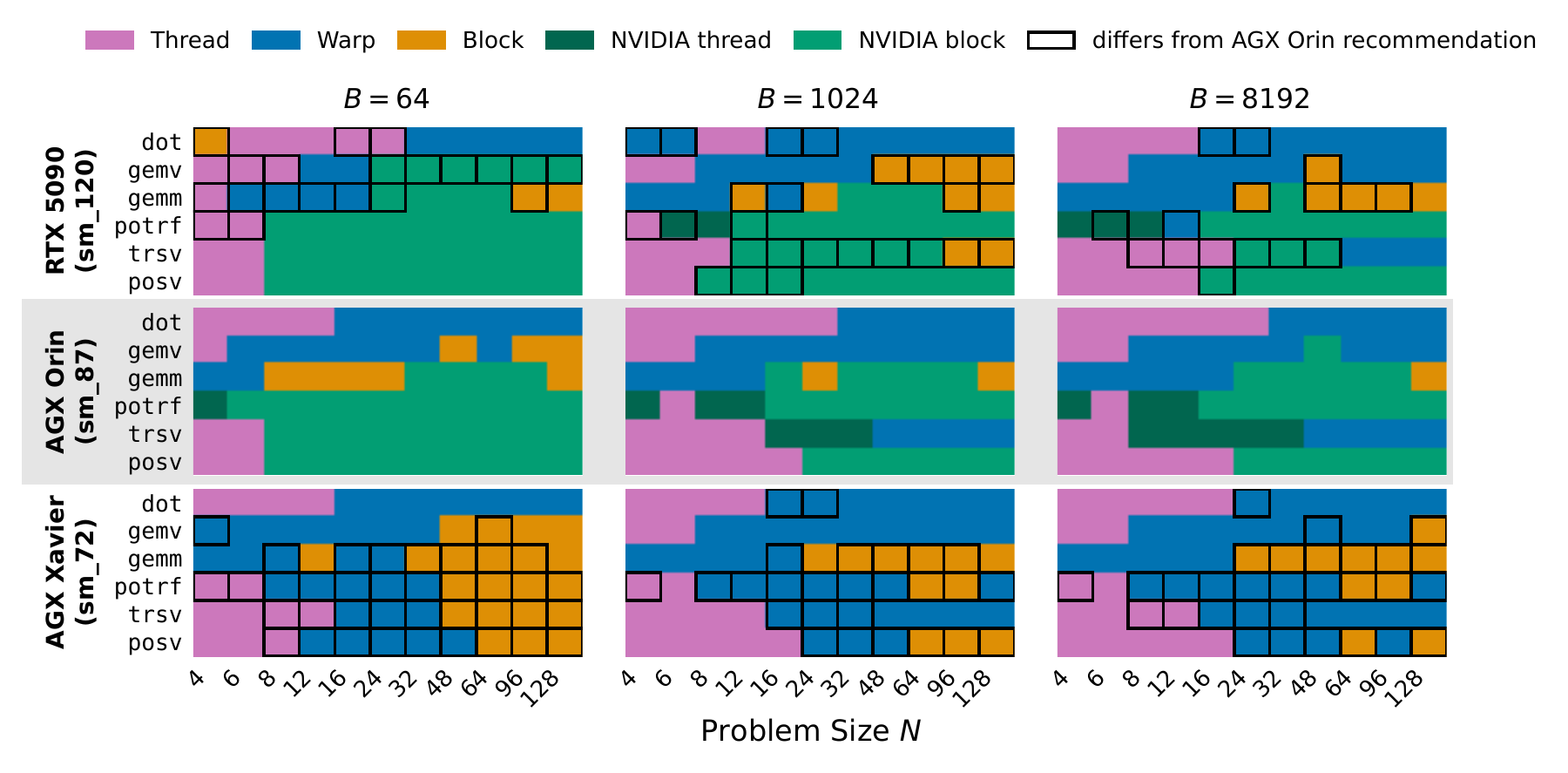
Fig. 1 Orin is the center shaded row. Colors identify execution tiers.#
Transferring native placements and launch configurations between architectures adds 4–20% geometric-mean runtime; 95th-percentile penalties reach 2.59×. One Orin fp64 GEMM launch exceeds RTX shared-memory capacity, leaving 395 transferable cells in that direction.
On the measured Orin, reducing the power ceiling from 50 W to 30 W and 15 W increases geometric-mean runtime by 29% and 91%, while each changes 9/396 recommendations. This supports reuse within these measured power modes. Complete tuning took 5.5 hours on Orin, 9 on Xavier, and 2 on RTX 5090.
Host libraries and compiler frameworks#
GLASS is faster than the per-cell best of PyTorch/JAX in 359/378 Orin cells across both precisions, with reported geometric means of 4.3–9.5× and a 73× peak. RTX 5090 wins 320/378 at 1.5–2.6× geometric means and up to 12×.
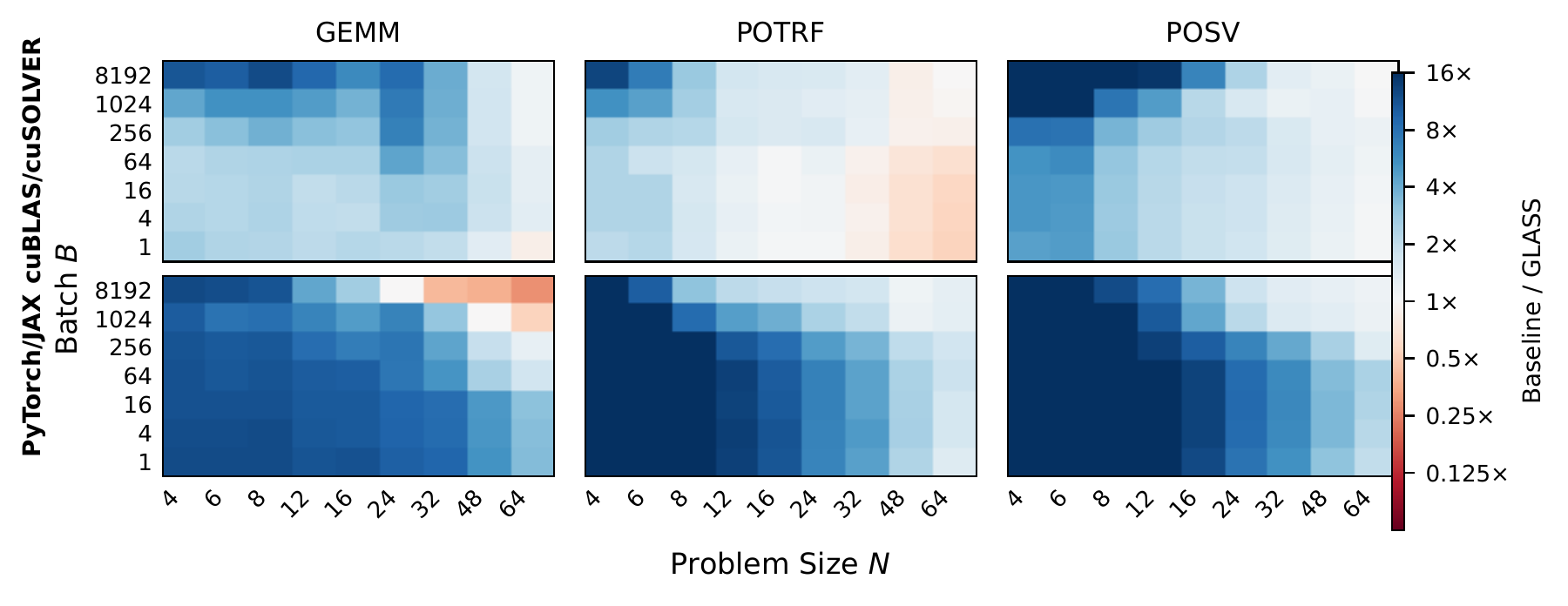
Fig. 2 Above one favors GLASS. Colors are clipped at 16×; the true maximum is 113.9×. This fp32 figure is a subset of the 378-cell comparison.#
In fp32, GLASS beats cuBLAS/cuSOLVER at every measured batch for POSV through N=64, GEMM through N=48, and POTRF through N=24, reaching 113.9×, 12.1×, and 12.8× respectively. These universal ranges do not extend to fp64. The 73× framework peak is fp32 POSV at N=4, B=8192. Larger problems include regions where host libraries or compiler frameworks regain an advantage.
Robotics operations and composition#
Representative Orin fp32 robotics operations at B=4096 gain 3.5–9.7× from the best fine-grained placement versus whole-block execution. Thread scope wins most rows; fp32 softmax favors a warp.
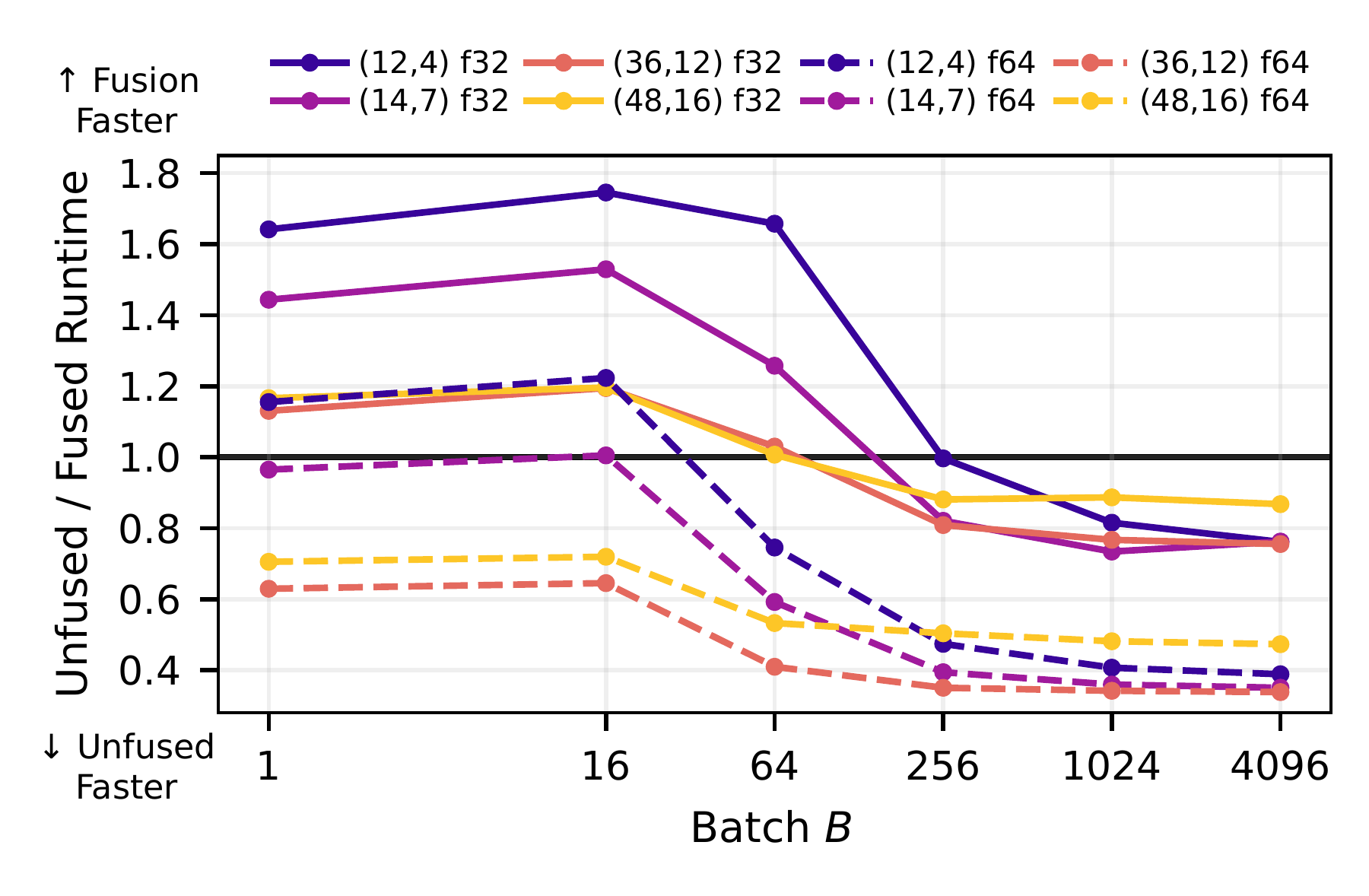
Fig. 3 Above one favors fusion. Solid curves are fp32; dashed curves fp64.#
Fusion improves the measured Riccati composition by up to 1.75× at small batches. Unfused GLASS wins by up to 2.9× at larger batches and in resource-heavy fp64 cases. This comparison isolates composition within GLASS rather than attributing the full host-vendor gap to fusion.
Integrations in published robotics systems#
Sampling-based MPC: replacing bespoke reductions exposed a numerical bug whose repair was accepted upstream. Relative to the corrected baseline, GLASS speeds the replaced computation by 1.21–1.50× on Orin over 128–8192 rollouts (1.21–1.46× on RTX 5090).
Batched IK: approximately 355 lines of specialized numerics become 29 lines of application code (92% less). At batch 2,000, Orin runtime changes from 9.94 ms to 7.92 ms (1.26×); RTX 5090 improves by 1.02×.
See Tuning for Your Hardware for retuning and Testing, oracles & receipts for independent numerical validation.